
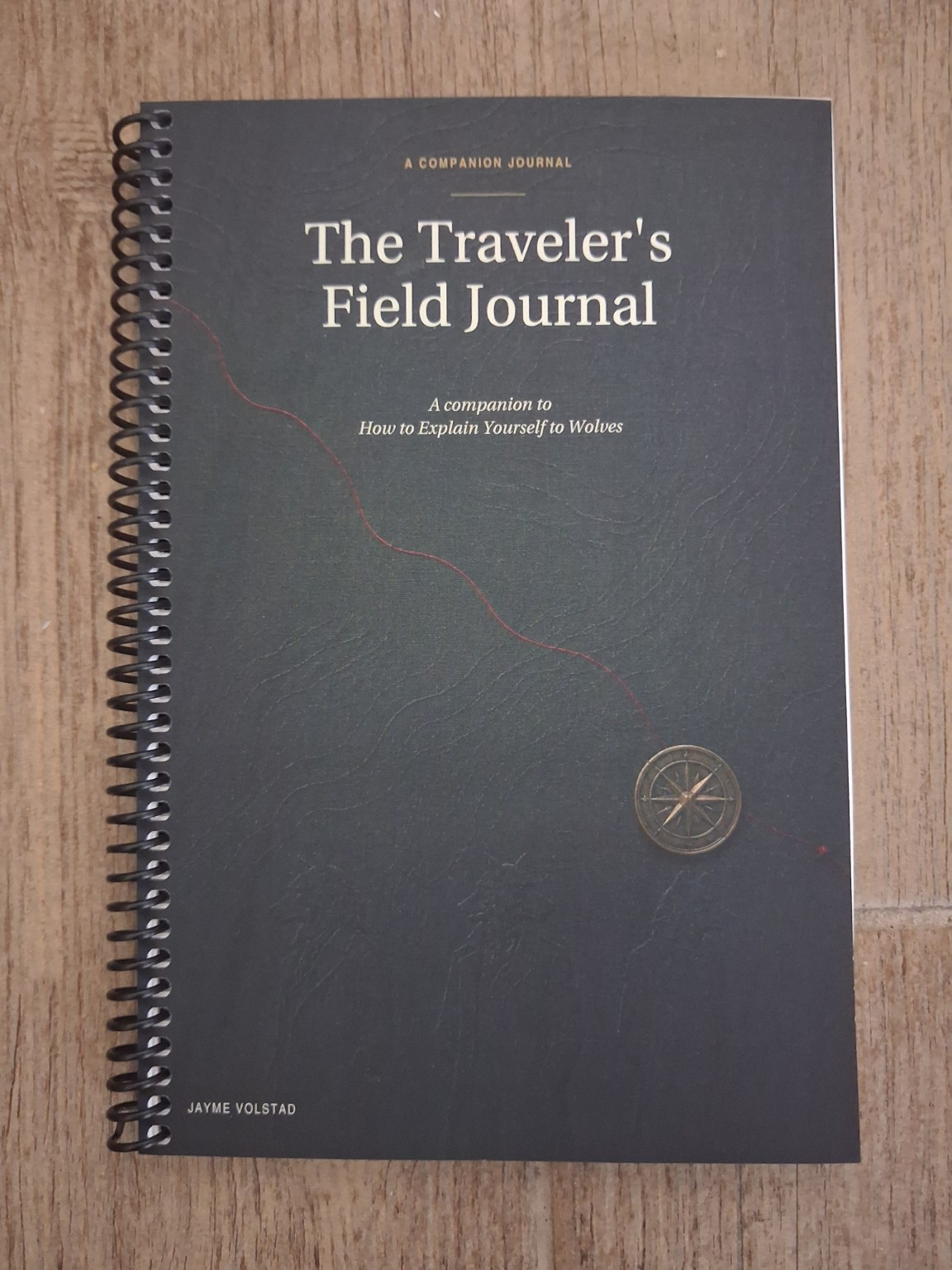
The Traveler's Field Journal
A companion to How to Explain Yourself to Wolves
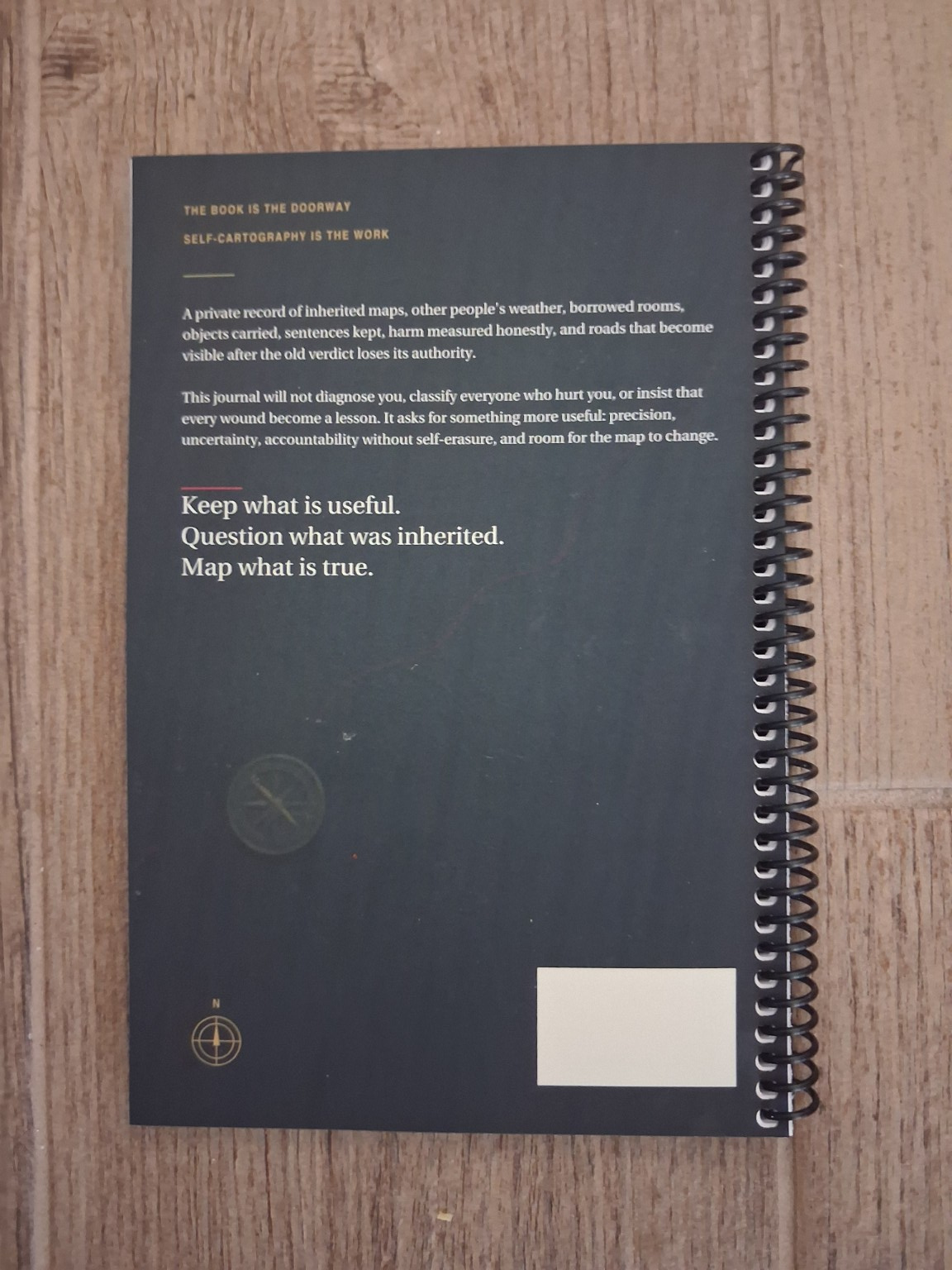
Keep what is useful.
Question what was inherited.
Map what is true.
A private field journal for people trying to make a more accurate map of their lives.
Not only what happened, but what you learned from it. What you were taught. What you inferred. What became necessary. What kept you safe once and followed you long after the emergency ended.
And, eventually, what is actually yours.
The journal takes the terrain of How to Explain Yourself to Wolves and turns it into a practice of self-cartography: separating observation from interpretation, intention from impact, responsibility from self-erasure, inherited directions from chosen ones, and another person's weather from your own.
You are not asked to produce a better explanation of yourself. You are asked to notice the map you have been using.
Printed and fulfilled on demand through Lulu
Eight routes. Not eight answers.
The journal moves through familiar territory from the book:
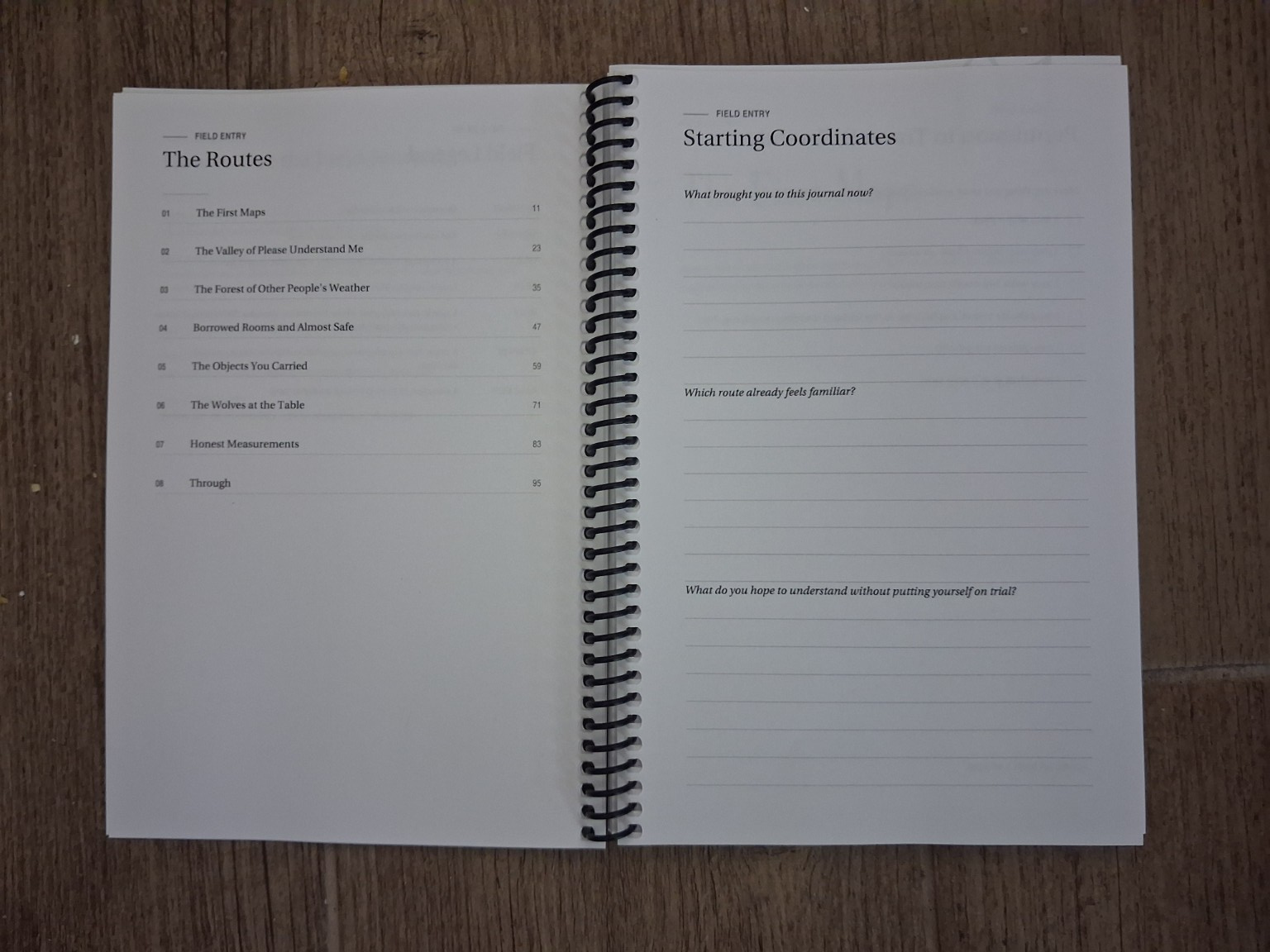
The First Maps
What were you handed before you were old enough to question it?
The Valley of Please Understand Me
When did explanation become evidence, defense, currency, or permission?
The Forest of Other People's Weather
What did you learn to monitor before you learned to ask what you needed?
Borrowed Rooms and Almost Safe
What gave you shelter? What did staying require?
The Objects You Carried
Which protections, roles, promises, and emergency tools are still in your pockets?
The Wolves at the Table
What happens when you keep arguing a case after the verdict has already been written?
Honest Measurements
What happened? What did you assume? What did you intend? What was the impact? What remains uncertain?
Through
What direction becomes available when certainty is no longer the price of movement?
The routes are not stages of healing and they are not a personality system. They are places to stand while you look at the map.
A field legend for things that are easy to mix together
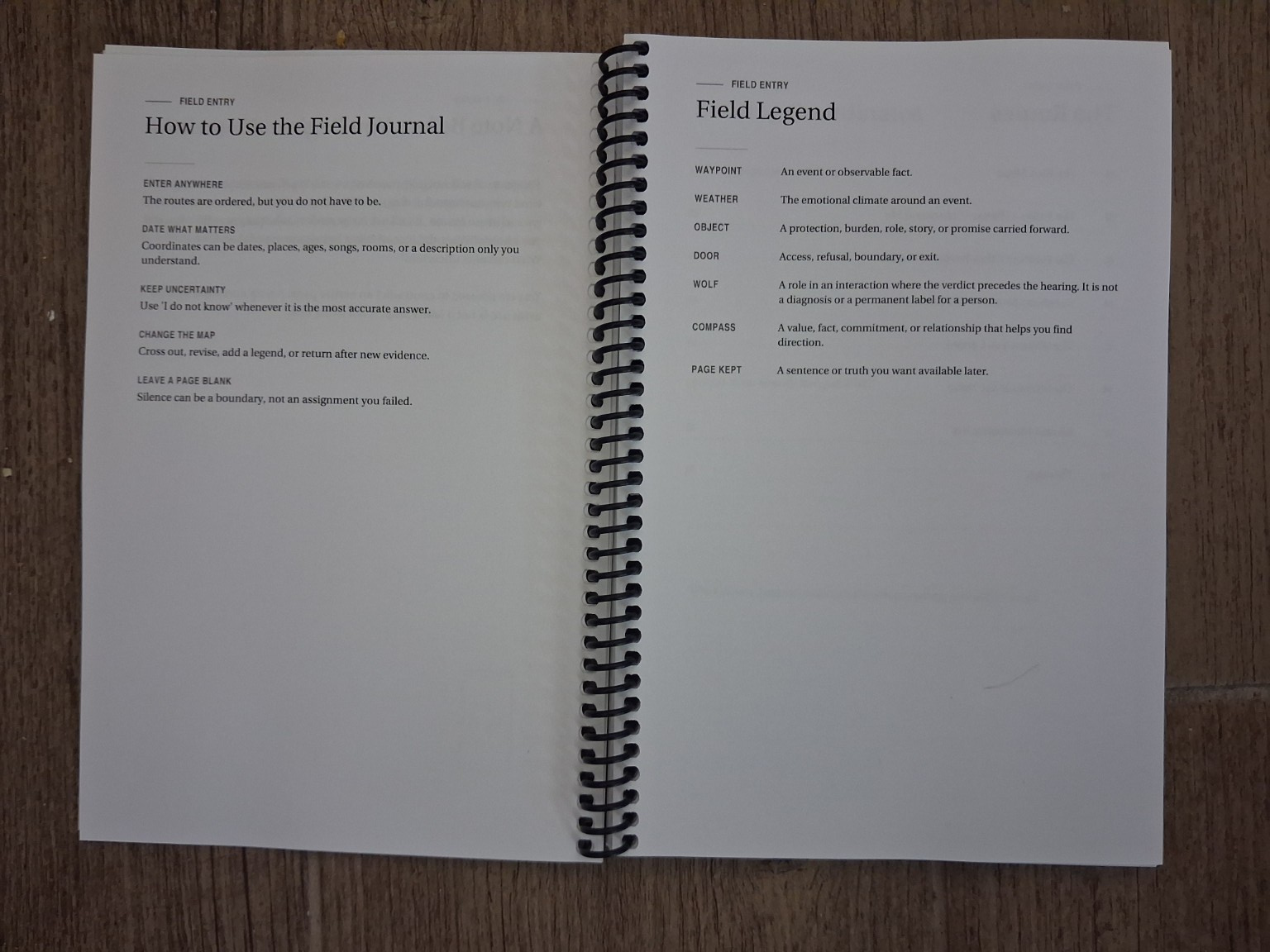
The emotional climate surrounding an event. Real, consequential, and not automatically yours to control.
Something observable enough to put on the map without explaining what it means.
A role, protection, belief, promise, burden, or tool carried forward.
Access. Refusal. Permission. Boundary. Exit.
A position in an interaction where explanation is being demanded but understanding may no longer be the actual task.
Something that helps establish direction when the map cannot provide certainty: a value, fact, responsibility, commitment, or relationship.
A sentence that remains true after the argument around it has ended.
The legend is not there to diagnose anyone. It is there because observation, fear, interpretation, memory, responsibility, and uncertainty should not all have to occupy the same box.
Inside the Journal
The exercises borrow the book's language, but the work is your own.
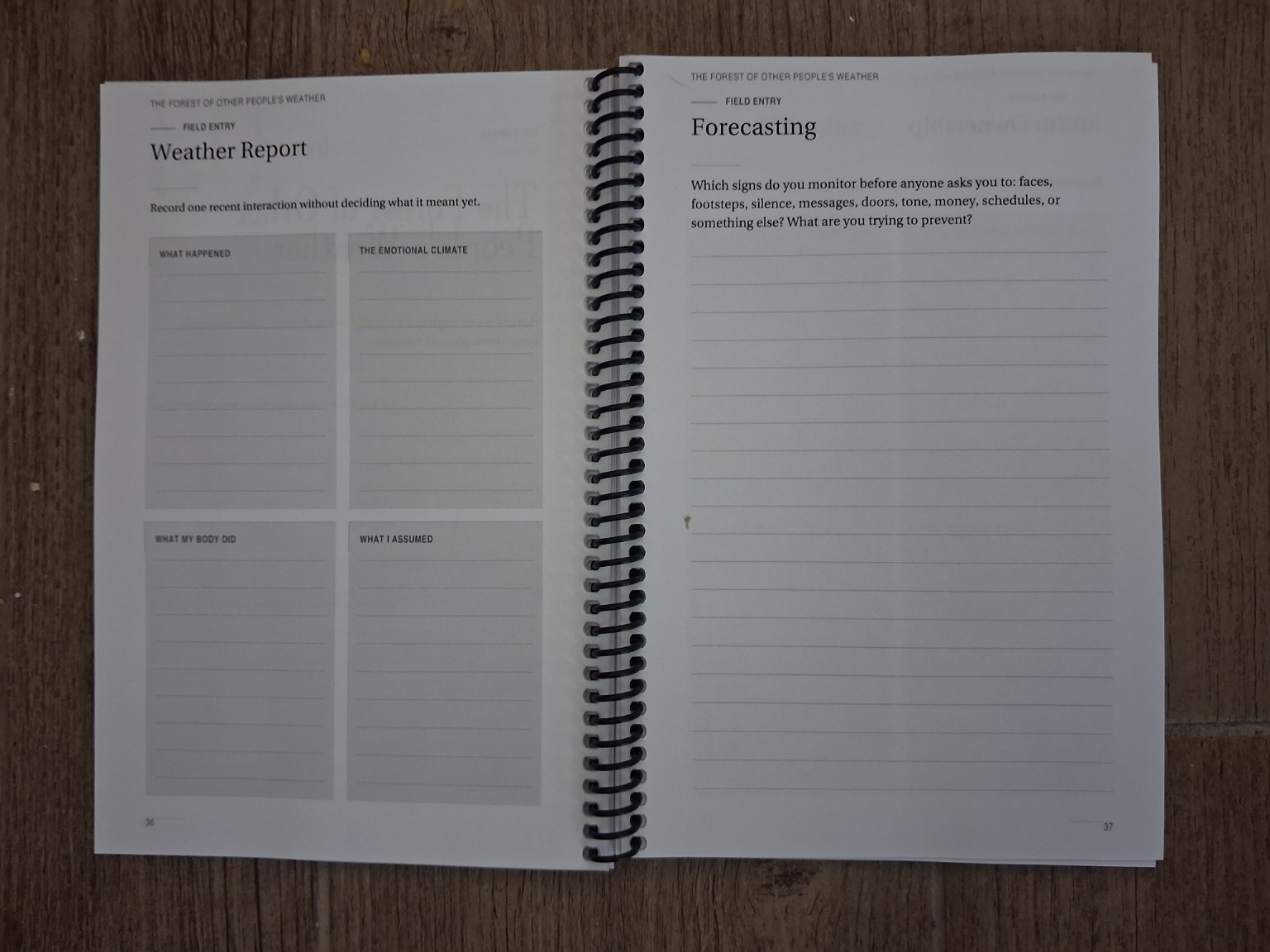
Weather Report & Forecasting
“Sometimes the map changes when observation and interpretation stop occupying the same box.”
Disentangling facts from incoming assumptions and emotional barometrics
- ·What actually happened (the waypoint: observable words and actions)
- ·The emotional climate (the weather in the room)
- ·What my body noticed first before rationalizing
- ·What I assumed or tried to prevent
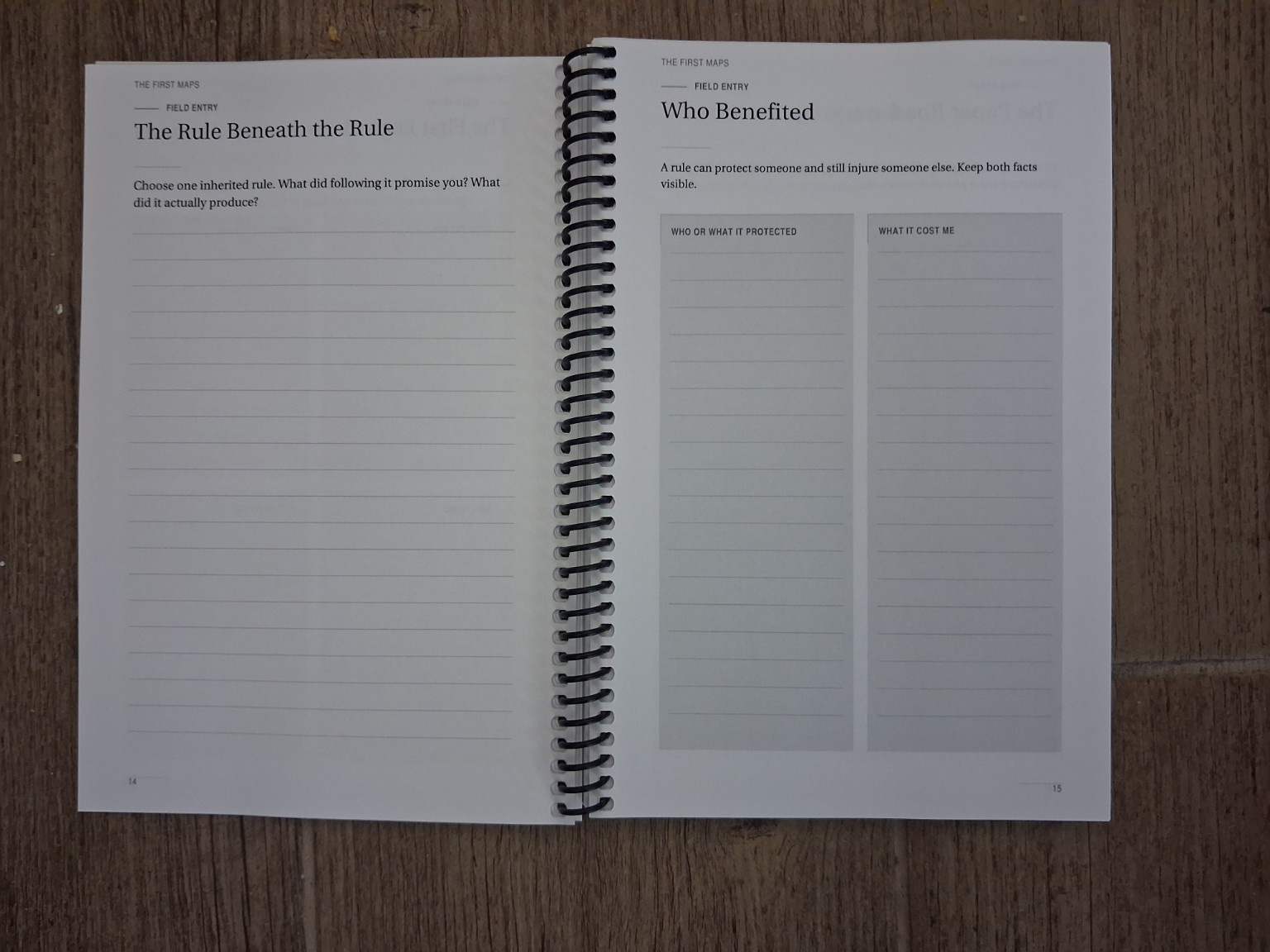
The Rule Beneath the Rule / Who Benefited
“Some rules don't sound like rules because you've obeyed them your entire life.”
Examining unexamined rules and what following them promised vs. produced
- ·Choose one inherited rule you learned to follow reflexively
- ·What did following it promise you? (Safety, approval, avoidance of conflict)
- ·What did it actually produce in your daily life?
- ·Who benefited from your compliance?
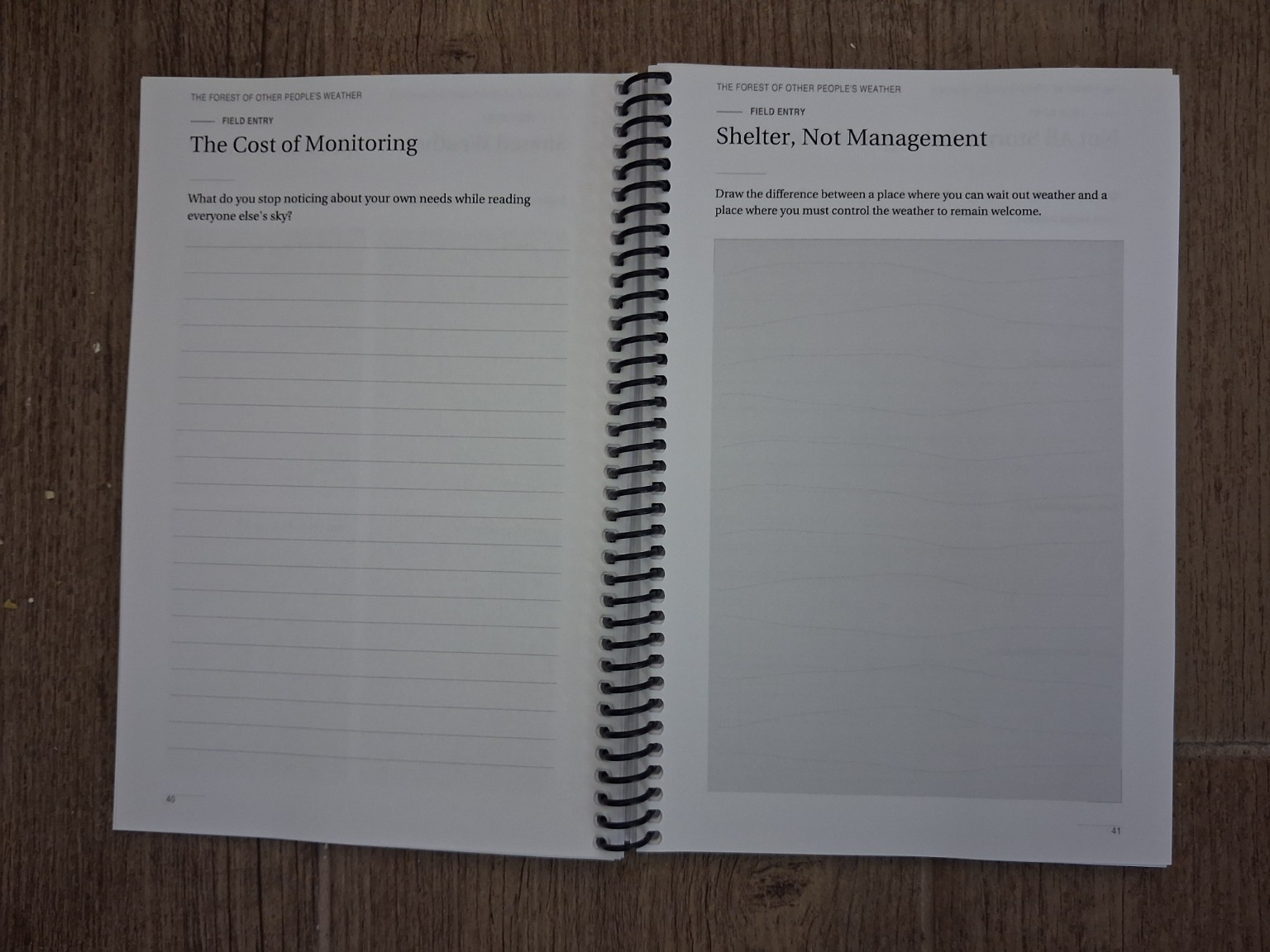
The Cost of Monitoring / Shelter, Not Management
“How much of your day is spent monitoring a room you don't control?”
Measuring the daily toll of emotional barometrics and monitoring rooms you don't control
- ·The barometric pressure and cues you learned to read before speaking
- ·The physical and mental exhaustion of remaining the room's weather station
- ·Where you can wait out the weather without having to manage the storm
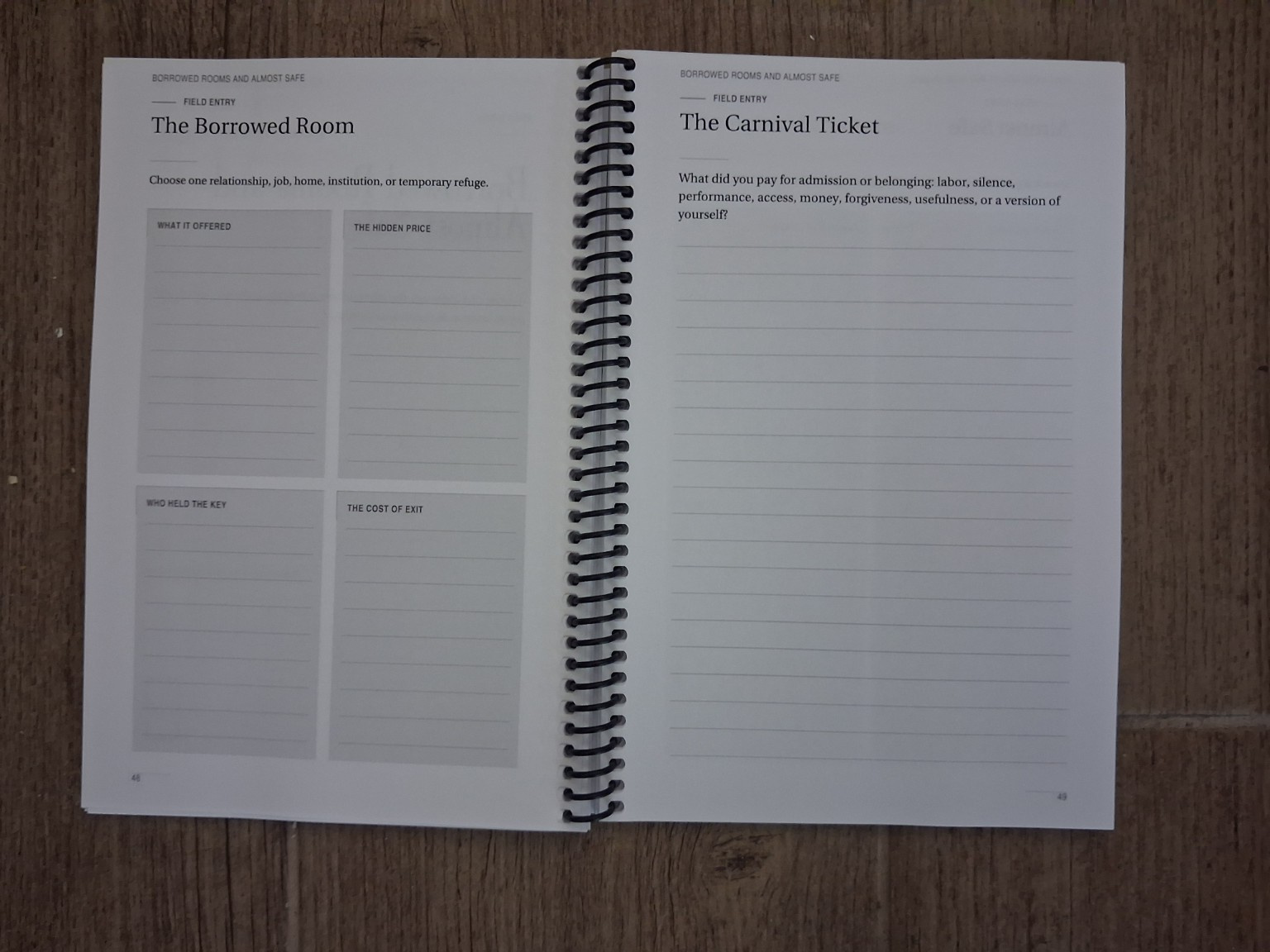
The Borrowed Room / The Carnival Ticket
“Every borrowed room comes with a key held by someone else, and a price that increases the longer you stay.”
Mapping temporary shelters, relationships, jobs, and institutions
- ·What the room or arrangement offered when you entered
- ·Who held the key and set the terms of occupancy
- ·The hidden price required to remain acceptable
- ·The real cost of exit
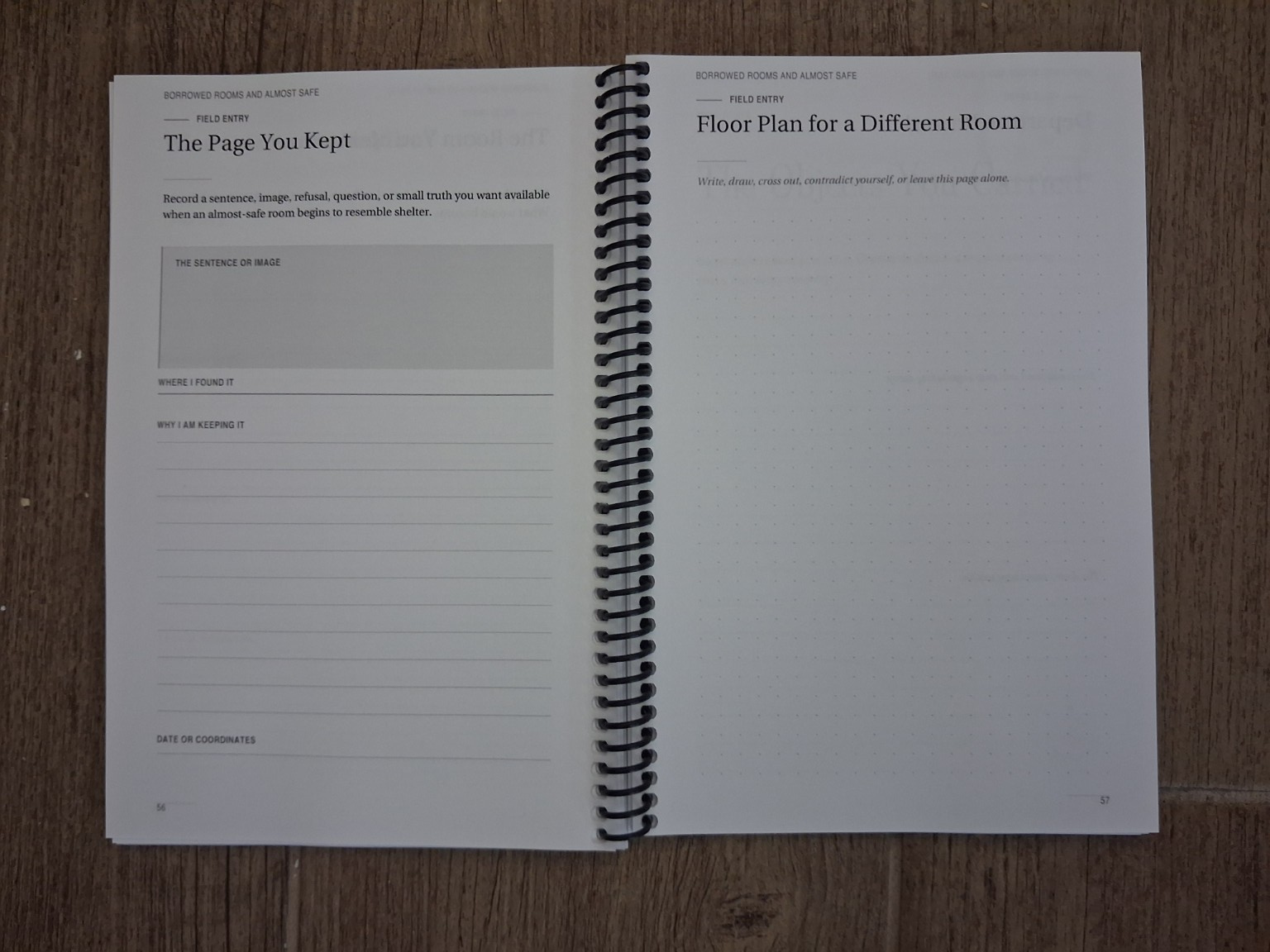
The Page You Kept / Floor Plan for a Different Room
“The page you kept is the truth that outlasted the argument.”
Preserving what remains true while drafting the perimeter of a new space
- ·The sentence, fact, or memory worth carrying forward
- ·Drafting a floor plan with boundaries you deliberately choose
- ·Who has access to the doorway
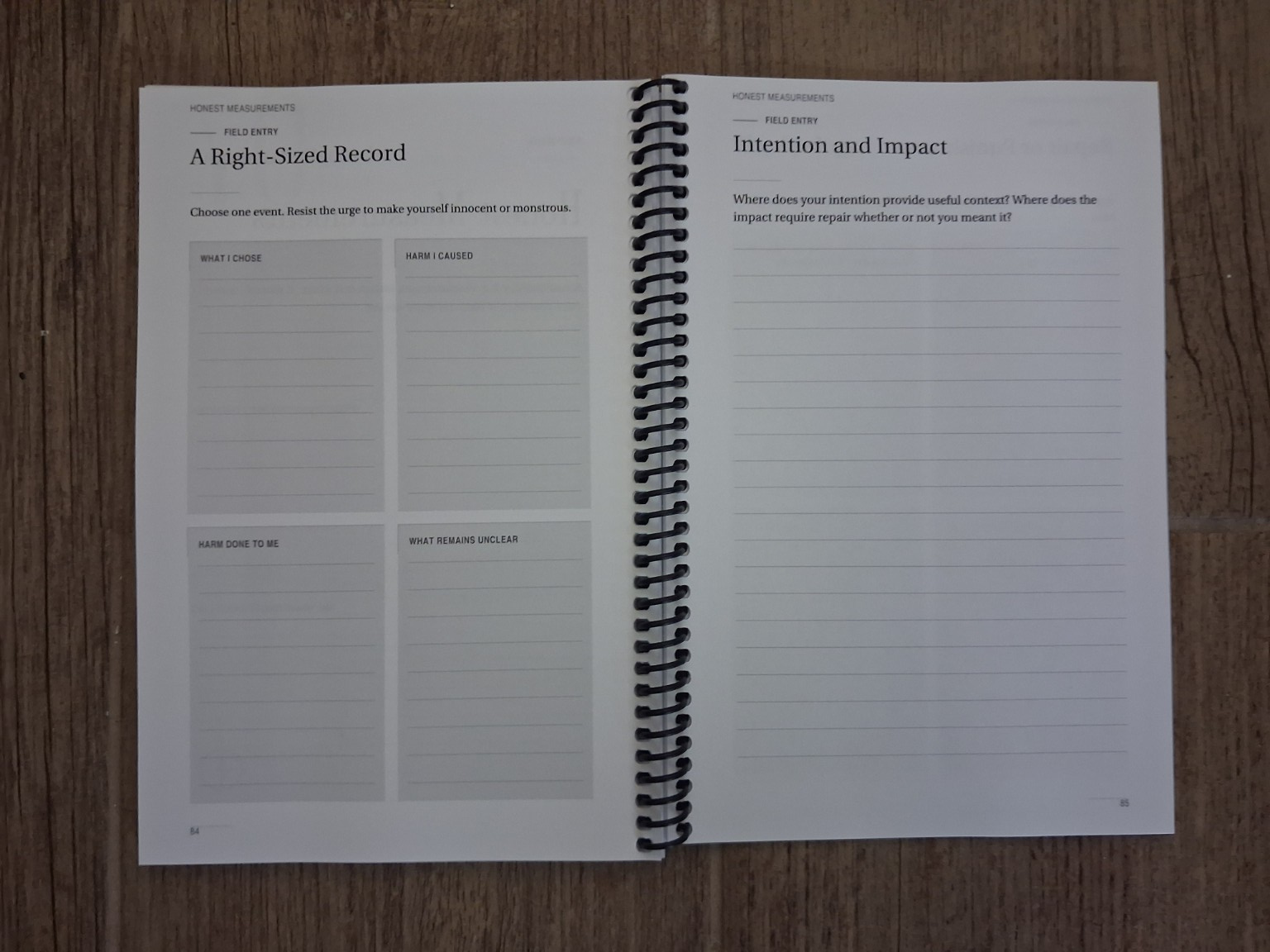
A Right-Sized Record / Intention and Impact
“Two things can be true at once: someone did not intend harm, and the damage is still real. Responsibility does not require self-annihilation.”
Disentangling verifiable facts from defensive explanations and self-blame
- ·The observable waypoint: what actually occurred on the record
- ·The intention vs. the experienced impact on the relationship
- ·Where your boundary began and where the other person's weather ended
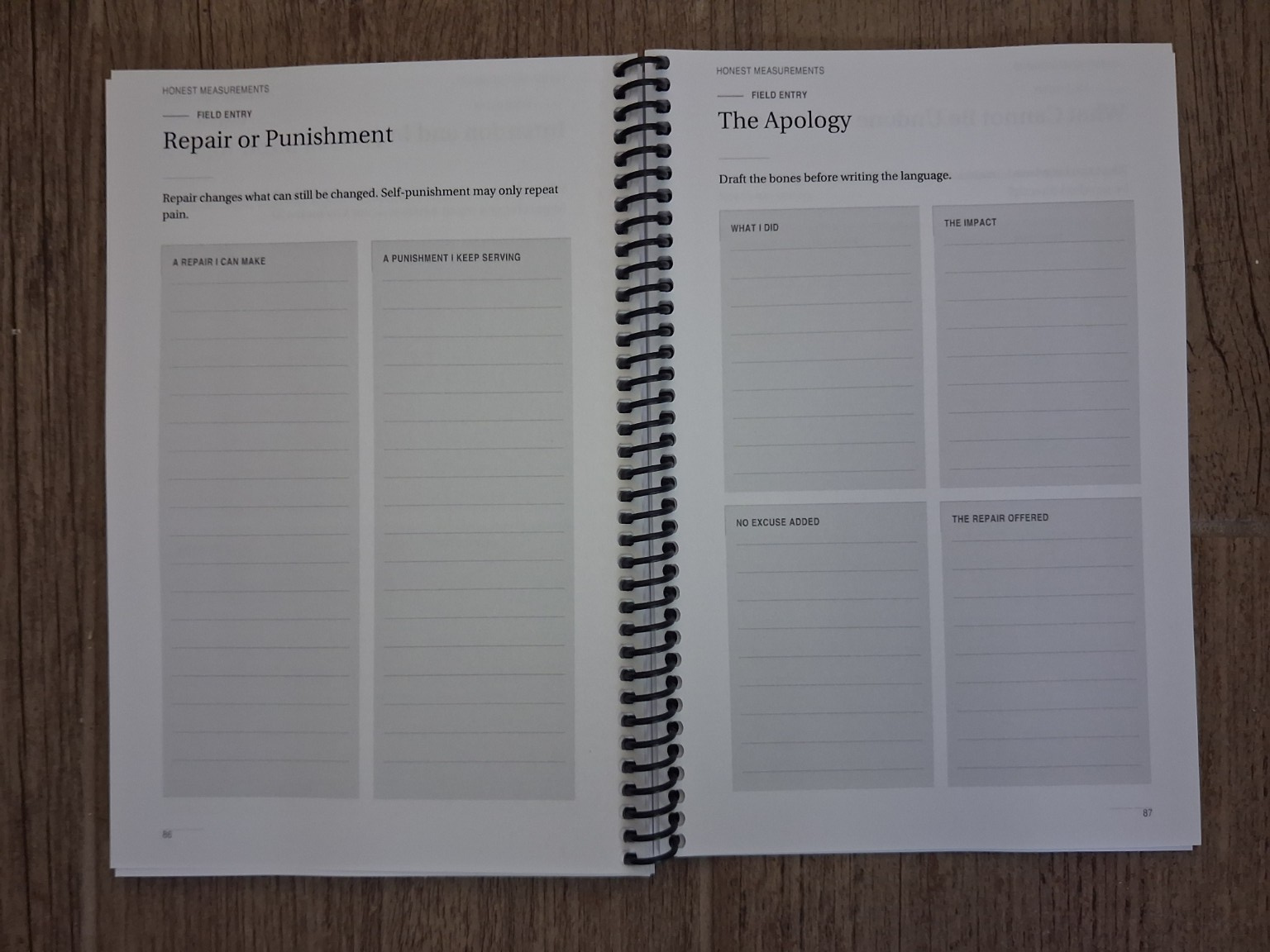
Repair or Punishment / The Apology
“Repair changes what can still be changed. Self-punishment may only repeat pain.”
Discerning between genuine relational repair and enduring repetitive penalty
- ·What genuine repair actually requires on the ground
- ·What is being demanded under the guise of an apology or penance
- ·Recognizing when the hearing has concluded and further trial accomplishes nothing
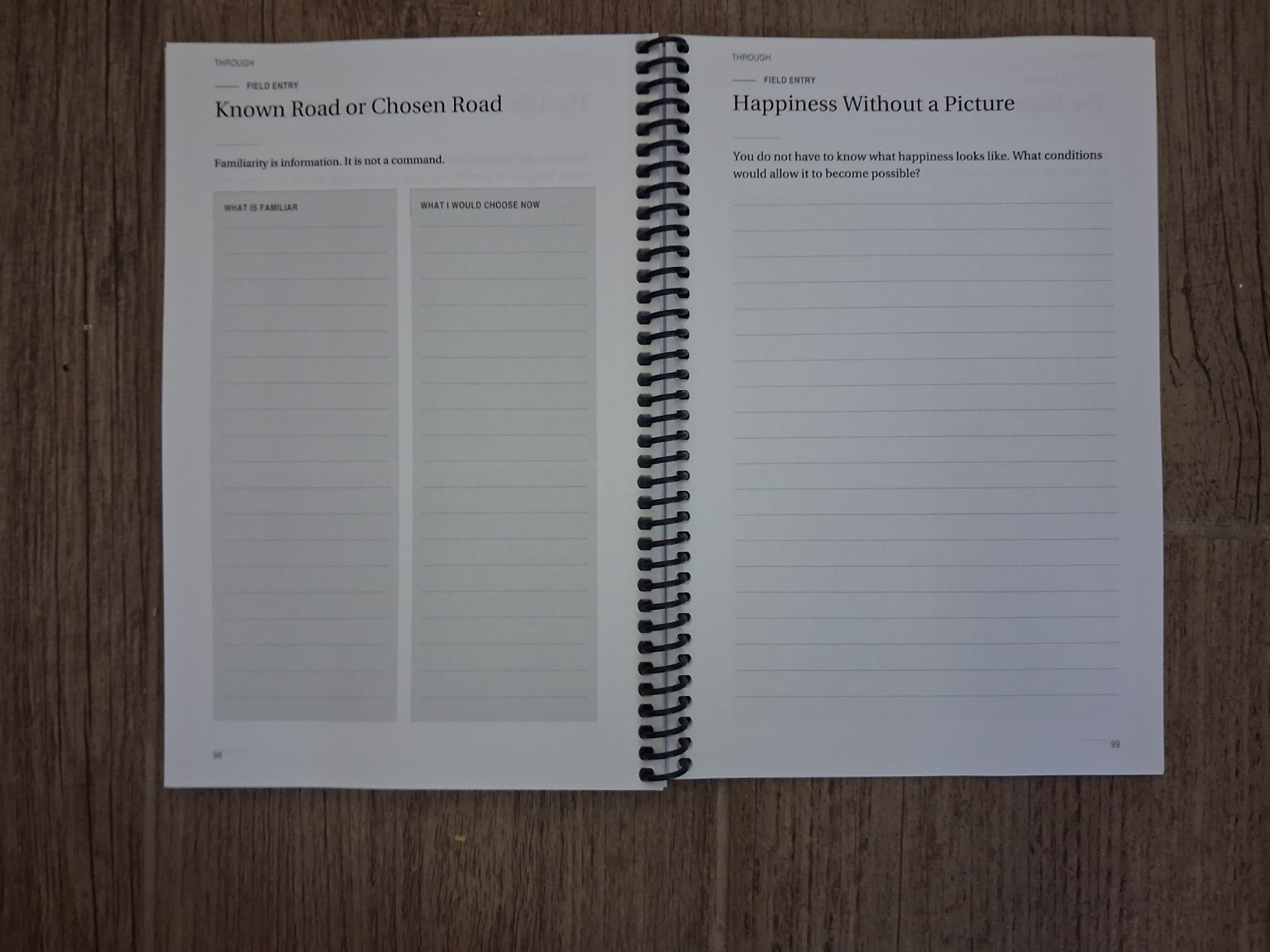
Known Road or Chosen Road / Happiness Without a Picture
“Familiarity is information. It is not a command.”
Examining whether a path is walked because it is familiar or because it was chosen
- ·The path walked out of reflex, duty, or inherited momentum
- ·The alternative direction that requires unlearning and quiet courage
- ·Permitting happiness without demanding a fully pre-rendered picture first
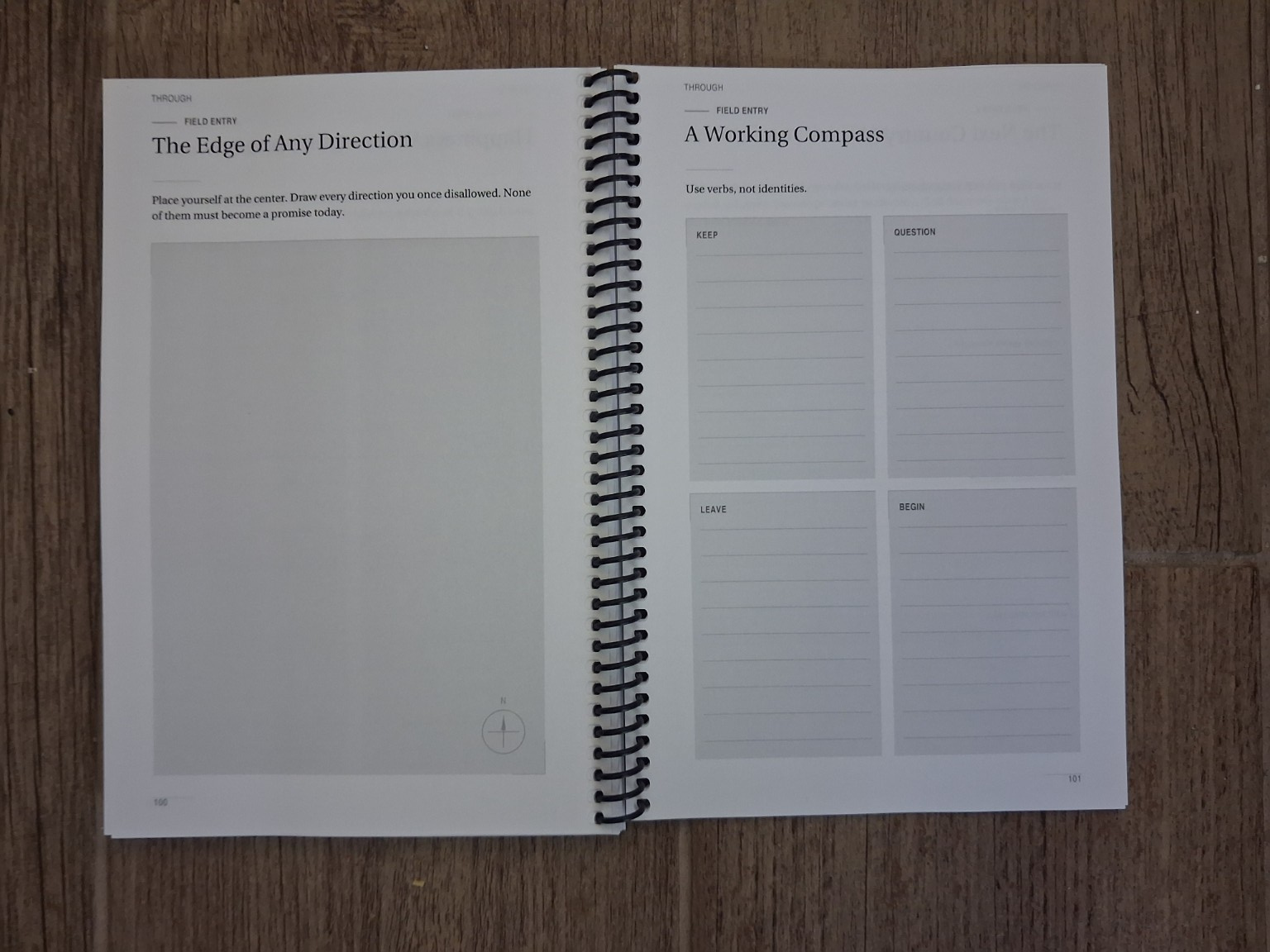
The Edge of Any Direction / A Working Compass
“A compass does not promise good weather or a smooth road. It only tells you which way is North when every tree looks identical.”
Calibrating internal values when external perimeters disappear
- ·The core value or truth holding steady under pressure
- ·Choosing a clear direction when the full horizon remains obscured
- ·Moving by internal alignment rather than seeking external permission
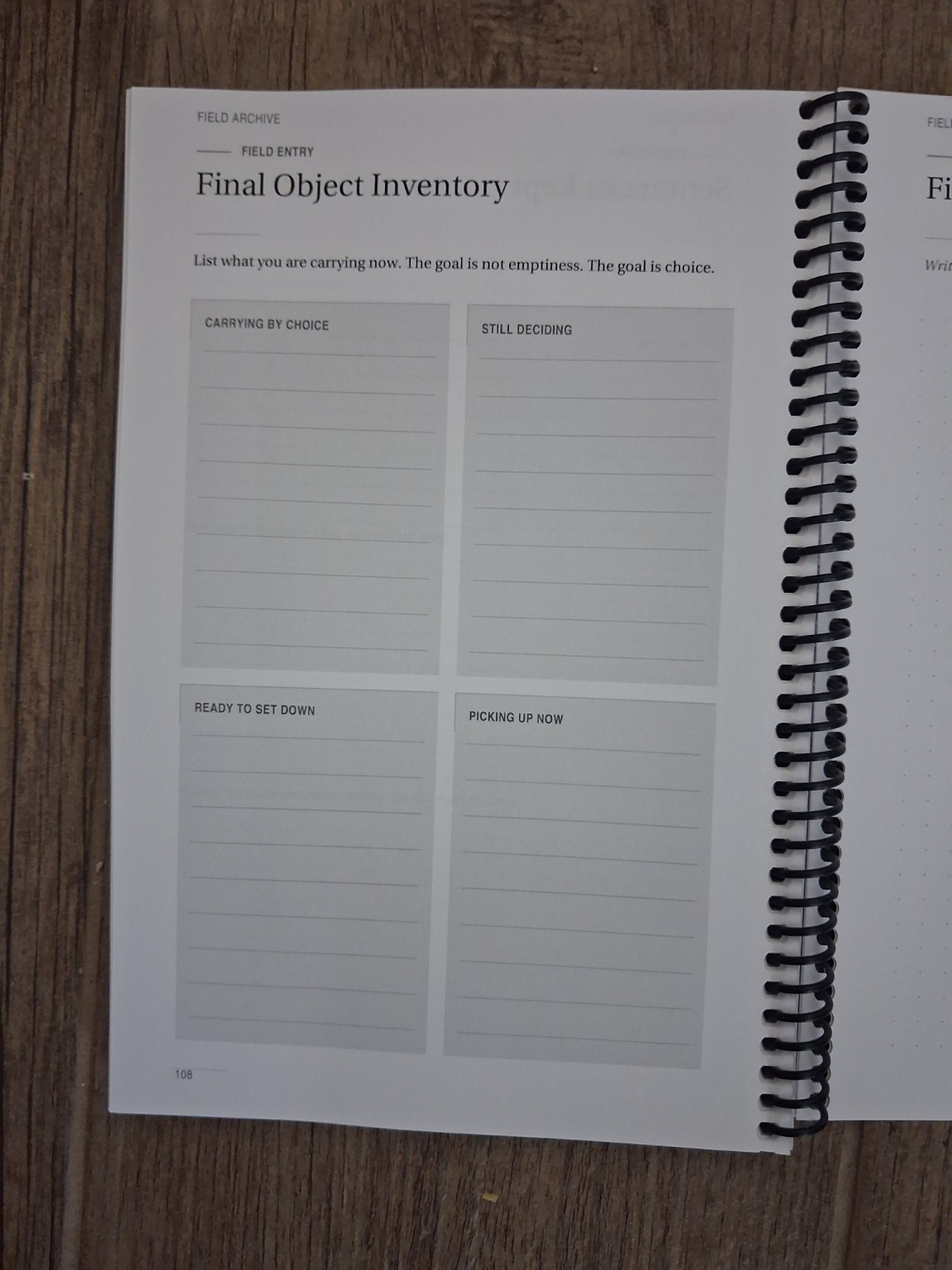
Final Object Inventory
“The goal is not emptiness. The goal is choice.”
Cataloging emotional relics, inherited roles, and burdens
- ·Objects, expectations, and roles inherited from others
- ·Protections that were essential during an emergency but are now obsolete
- ·What is deliberately chosen and carried forward into the next territory
This is not an instruction manual for becoming a different person. It is a way of seeing the structure already standing around you.
Some of it may need to come down. Some of it kept you alive. Some of it may still be worth keeping.
Why This Journal Exists
Most of us inherit maps before we know we are carrying them.
Family maps. Relationship maps. Maps made from fear, love, religion, class, survival, loyalty, shame, responsibility, experience, and whatever seemed to work the last time the weather became dangerous.
Some directions are useful.
Some were useful once.
Some were never true.
The difficult part is that they can look nearly identical when folded in your pocket.
Self-cartography is the work of unfolding them.
Not to prosecute the person you were.
Not to acquit her either.
To determine what happened, what she built in response, what still belongs to her, and what she wants to build with now.
The Book is the Journey. The Journal is the Cartography.
How to Explain Yourself to Wolves follows a girl through inherited maps, other people's weather, borrowed rooms, impossible hearings, things carried too long, things she did wrong, things done to her, and roads whose endings were unavailable when she had to choose them.
The Traveler's Field Journal takes the questions underneath that journey and gives them somewhere to be worked on paper.
You do not need to have read the memoir first.
You also do not need a complete picture of where you are going.
A map can begin with something smaller: You are here.
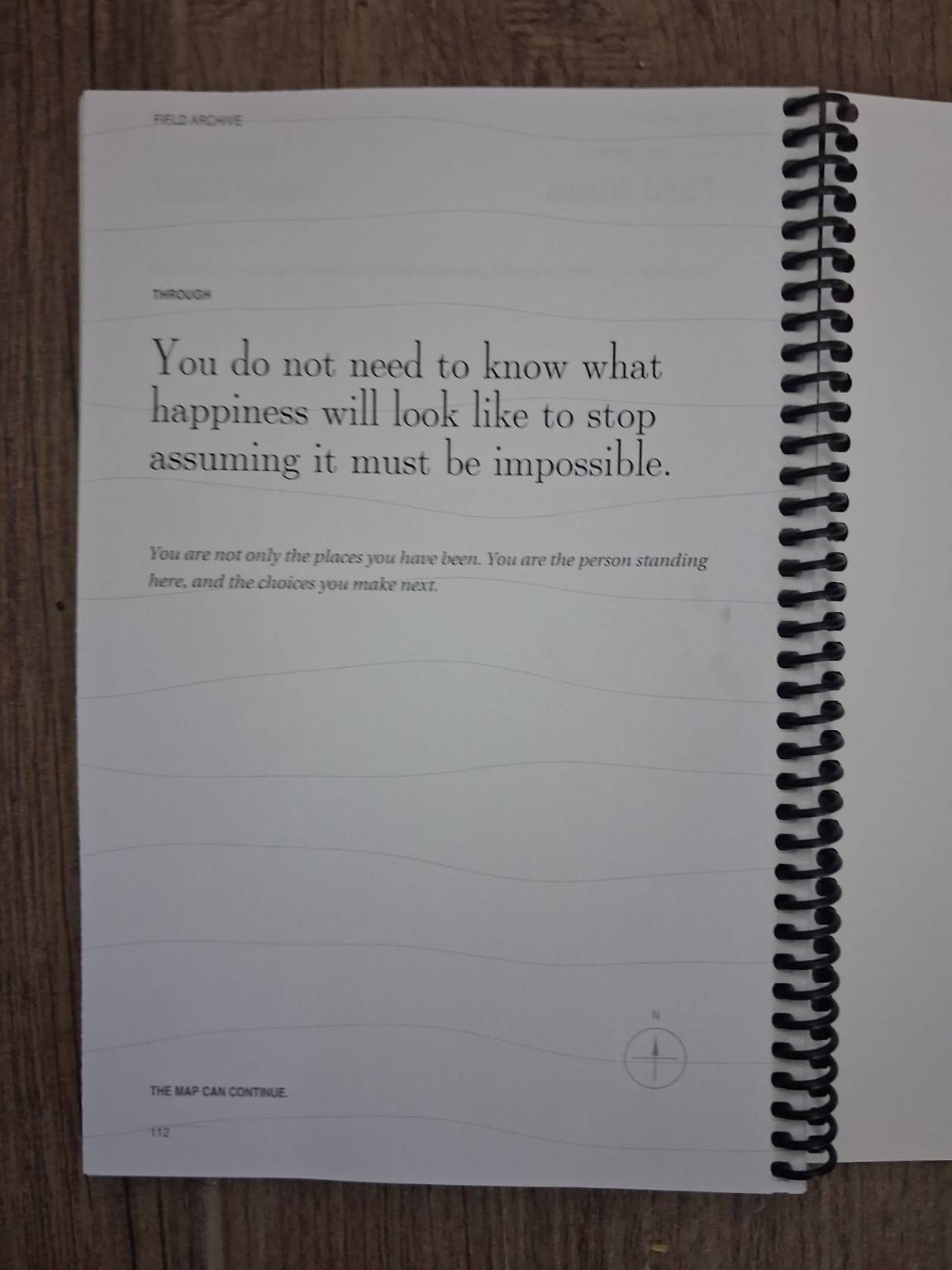
Through
Through is not the place where everything finally makes sense.
It is what remains when making everything make sense is no longer required before you move.
A compass does not guarantee the road.
A map does not guarantee good weather.
And knowing where you are does not tell you exactly who you will become there.
It gives you something quieter and more useful:
a direction you chose yourself.
Physical Specifications
You do not need a perfect map. You need an honest one.
The Traveler's Field Journal · Spiral-Bound Companion Edition
Coil-bound to lay flat for continuous fieldwork. Printed and fulfilled on demand through Lulu.
Having trouble with checkout? Order through Lulu