
Wolves Logo Watermark
How to Explain Yourself to WolvesBy Jayme Volstad
Return to ThresholdA method for determining where you are
READER FIELDWORK

Self-Cartography

A method for determining where you are.

I’ve spent a lot of my life in rooms I didn’t choose.

Kitchens. Hospital rooms. Jail cells. Borrowed bedrooms. Other people’s houses. Other people’s floors. Courtrooms. Waiting rooms. Rooms where everyone seemed to know the rules except me.

After enough of them, I started noticing how often people move through life using maps they have never actually looked at.

We say we know what matters to us, but many of us have never sat down and named our values clearly enough to recognize when our lives stop matching them. There can be an enormous distance between who we believe we are, who we want to be, and what our actual choices reveal.

We try to understand other people without always understanding ourselves—or what makes either of us feel loved, threatened, cornered, safe, rejected, needed, or seen.

We struggle to recognize where boundaries are needed, how to set them, or why some of them feel almost impossible to hold. We move through our days without always noticing what drains us, what restores us, or how much of our energy is being spent maintaining things that no longer fit.

We repeat relationships without examining the roles we keep accepting inside them. We react to old alarms as though every danger is happening for the first time. We carry grief, expectations, inherited rules, survival strategies, and ideas about love that may have been handed to us long before we were old enough to decide whether we agreed with them.

I’ve worked through guided journals and reflection exercises before. Some gave me useful questions. Some were beautifully made. But too often I ended with a page full of answers and no clearer idea what those answers had to do with one another—or what I was supposed to do next.

Self-Cartography is meant to go further.

It begins underneath the obvious questions: what you actually value, what you actually do, where those things align, and where they do not.
SCOPE OF INQUIRY

Areas the Work Will Explore

From foundational alignment to active relational practice:

01.

Personal Values

What genuinely matters to you—not simply what you were taught should matter.

02.

Identity & Alignment

The distance between who you believe you are, who you want to become, and the patterns your behavior currently reflects.

03.

Inherited Rules & Survival Patterns

The beliefs, roles, habits, and strategies you learned because they once helped something feel safer, steadier, more understandable, or more survivable.

04.

Boundaries & Boundary Code

Where your limits actually are, why some are difficult to recognize or hold, what happens when they are repeatedly crossed, and what you are no longer willing to negotiate away.

05.

Energy & Capacity

What drains you, restores you, overwhelms you, demands too much of you, and what you keep spending yourself to maintain.

06.

Triggers & Cues

What sets off the alarm, what your mind or body believes is happening, and whether the present moment actually matches the danger it recognizes.

07.

Relationships & Relational Patterns

The roles you repeatedly take on, what you seek from people, what you tolerate, what you fear losing, and what you sometimes mistake for connection.

08.

Perspective & Empathy

How to understand another person’s experience without automatically treating their interpretation as the final truth—or abandoning your own.

09.

Communication & Conflict

How you explain, withdraw, appease, pursue, defend, misunderstand, repair, and recognize when additional explanation is no longer accomplishing anything.

10.

Grief & Loss

Not only people we lose, but identities, futures, relationships, possibilities, versions of ourselves, and things that cannot be repaired back into their original shape.

11.

Emerging Code

Taking what you have learned and deciding deliberately how you want to operate from here.

The goal is not to produce a prettier explanation of yourself.

It is to understand your own terrain well enough to move through it deliberately.

Sometimes that means finding an answer.

Sometimes it means understanding why the answer keeps changing.

Sometimes it means accepting what cannot be changed.

And sometimes it means realizing you already have enough information to stop walking back to the same locked door.

FIELDWORK DISPATCHES

Receive Fieldwork Dispatches & Exercises

Leave an email address to receive occasional notes, field exercises, and writings from the territory.

Field dispatches, new essays, Self-Cartography releases, and occasional notes from the road. Unsubscribe anytime.

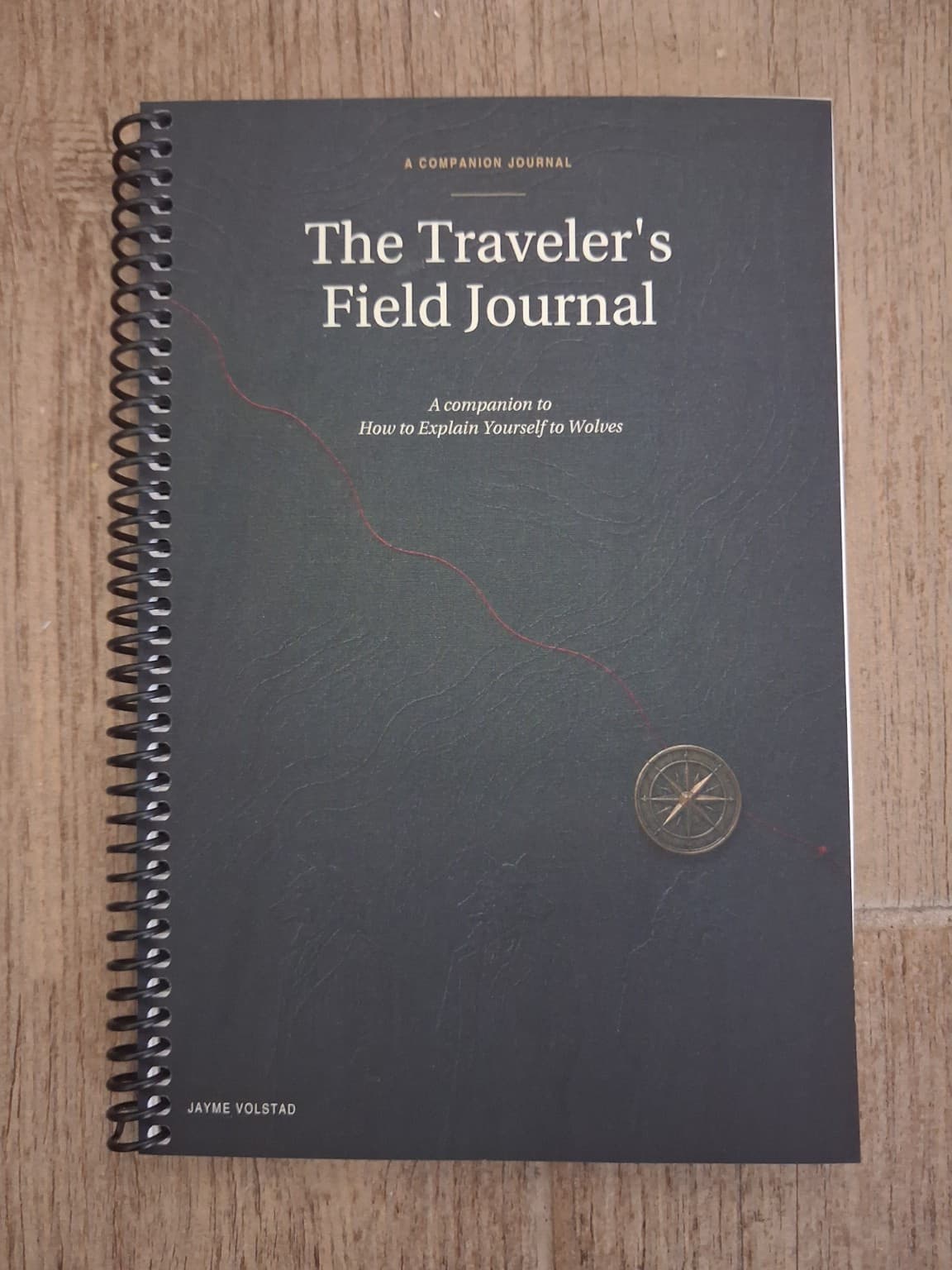
The Traveler's Field Journal - Real physical coil-bound front cover
COMPANION PHYSICAL WORKBOOK

The Traveler's Field Journal

A coil-bound companion designed to lay flat on a worktable. Blank cartographic grids, reflection prompts, and physical instruments derived from the allegorical world of How to Explain Yourself to Wolves.